
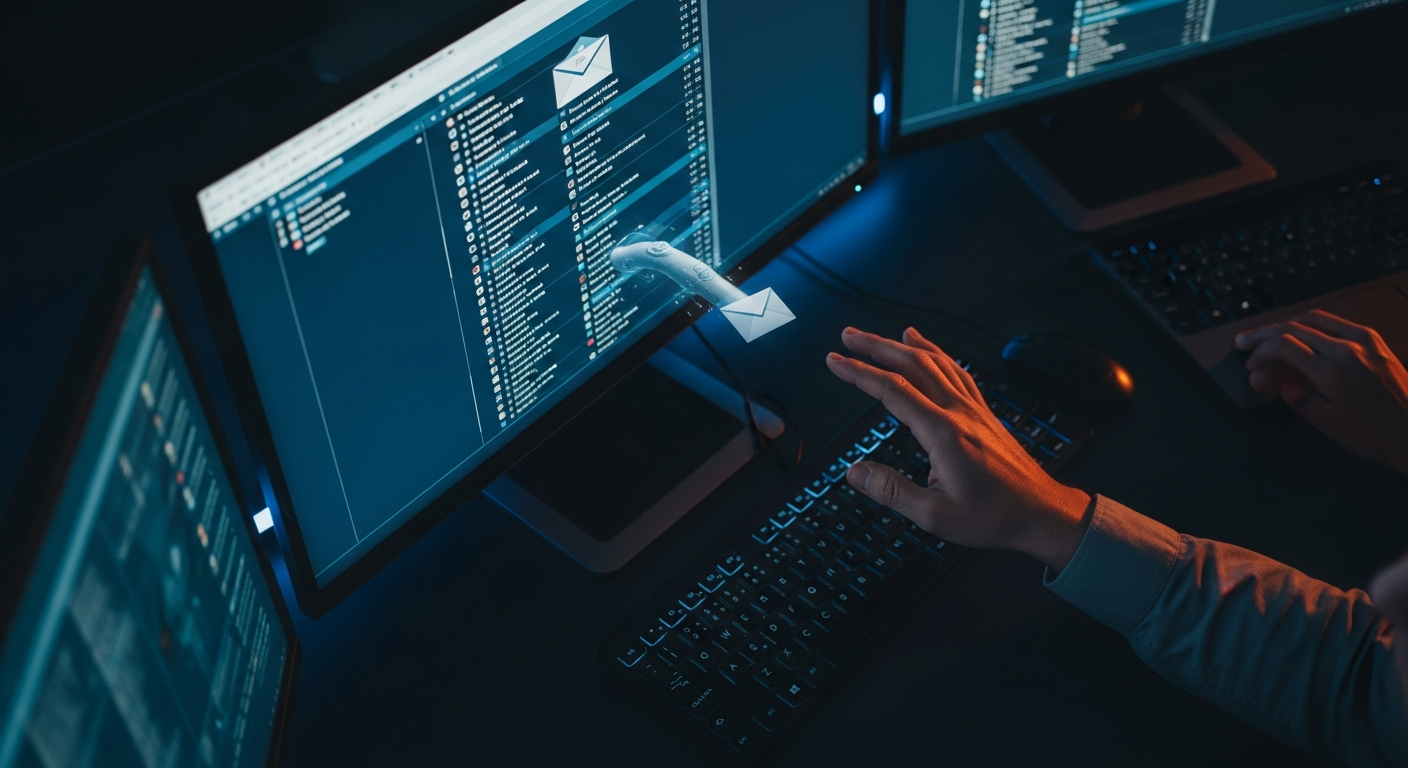
AI-generated phishing has quietly dismantled a decade of security awareness training. The grammar mistakes, the odd phrasing, the sender name that felt slightly off — those were the tells. Employees learned to look for them. Security teams trained entire workforces to catch them. Then threat actors started using large language models and eliminated nearly all of them. Today’s AI-generated phishing emails are grammatically perfect, contextually credible, and personalized to the recipient’s role, employer, and professional network. The 2024 and emerging 2025 data is stark: detection failure rates on AI-crafted phishing are outpacing every metric the industry used to measure training effectiveness.
- The Old Playbook and Why It Worked
- What AI Changed About Phishing Construction
- What the 2024 and 2025 Data Actually Shows
- Who Is Being Targeted and How
- Real-World Incidents and Disclosed Breaches
- Why Awareness Training Alone Is a Systemic Failure, Not a User Error
- What a Credible Defense Posture Looks Like
- What to Ask Your IT Firm
The Old Playbook and Why It Worked
For roughly fifteen years, phishing defense rested on a simple premise: attackers were detectable because their tradecraft was imperfect. English was often not their first language. They operated at scale, blasting generic lures to millions of inboxes. The volume model meant they could not invest time personalizing each message. The result was a recognizable pattern — mismatched sender domains, oddly formal salutations, urgent requests that felt socially off, and the most reliable tell of all: grammatical errors a native speaker would never make.
Security awareness training formalized that pattern into a checklist. Employees learned to pause when an email felt wrong. Simulated phishing campaigns from vendors like KnowBe4 and Proofpoint reinforced the lesson monthly. Click rates on simulated lures dropped. The industry broadly accepted that trained humans were a meaningful last line of defense against credential theft and business email compromise.
That premise is now structurally broken. AI-generated phishing has made every one of those learned signals unreliable.
What AI Changed About AI-Generated Phishing Construction
Large language models do not make grammatical errors. They do not produce odd phrasing. Given the right prompt and context, they write prose that is indistinguishable from a trusted colleague’s email. More critically, AI-generated phishing can be built from public data — LinkedIn profiles, company news, press releases, job postings, conference speaker bios, published earnings — and use that data to construct a message that is not just grammatically correct but contextually accurate.
A threat actor targeting a controller at a mid-size manufacturer no longer needs to write a generic “urgent wire transfer” email. They can instruct an AI model to draft a message that references the company’s actual accounting system (mentioned in a job posting), the CFO’s name (from LinkedIn), a recent acquisition covered in the trade press, and the recipient’s professional background. The resulting AI-generated phishing email reads like something the CFO actually wrote, to someone who clearly works at that specific company, about a topic that is genuinely relevant to that person’s job.
This is not theoretical. IBM’s X-Force team published research in 2023 showing that AI-generated phishing emails achieved a 19% click-through rate in testing compared to 14% for human-crafted lures. The gap has widened since. What changed is not just quality — it is economics. A campaign that previously required a skilled social engineer hours of research per target can now be executed at scale, with equal or better personalization, in minutes.
What the 2024 and 2025 Data Actually Shows
The Verizon Data Breach Investigations Report 2024 documented phishing as the top initial access vector, present in over 14% of breaches — a figure that understates actual prevalence because it excludes cases where phishing was secondary to credential stuffing that originated from a prior phishing event. The report also flagged a significant increase in social engineering sophistication, with attackers demonstrating familiarity with internal organizational context that could only come from targeted research or prior access.
CISA’s 2024 advisory catalog included multiple alerts specifically calling out the use of AI tools in crafting phishing and voice-based phishing campaigns. Advisory AA24-242A, issued in August 2024, described a campaign against critical infrastructure organizations where attackers used AI-generated voice synthesis and AI-generated phishing email content in a coordinated multi-channel attack — hitting the same target by email, then by phone, then by a follow-up email referencing the phone call. Each touchpoint was polished, coherent, and contextually aware of the organization’s structure.
Microsoft’s 2024 Digital Defense Report documented a 58% year-over-year increase in phishing-as-a-service platforms, many of which now include built-in AI content generation as a default feature — not an advanced option. That commoditization means AI-generated phishing capability is no longer confined to nation-state actors. It is available to any criminal with a few hundred dollars and a subscription.
The FBI Internet Crime Complaint Center 2023 annual report — the most recent with fully aggregated data at time of publication — recorded business email compromise losses of $2.9 billion, reflecting only reported cases. Researchers consistently estimate actual losses are three to five times that figure. Preliminary 2024 data shared in FBI briefings indicates the number is tracking higher, with a notable increase in cases where victims described receiving emails they found completely credible on first read — a hallmark of AI-generated phishing.
Who Is Being Targeted and How
AI-generated phishing and AI-assisted spear phishing disproportionately target three roles: finance (controllers, CFOs, accounts payable staff), IT (helpdesk and system administrators who can reset credentials or grant access), and executive assistants (who have calendar and email access to senior accounts). These roles sit at the intersection of authority and access.
The targeting methodology has also evolved. Threat actors are no longer purely opportunistic. They conduct “harvest and wait” operations: purchase credential dumps from prior breaches, identify which addresses are still active and associated with high-value organizations, then use AI tools to build a personalized AI-generated phishing campaign against those specific individuals. The personalization data comes from:
- LinkedIn profiles, connection lists, and recent activity posts
- Company websites, press releases, and leadership bio pages
- Conference speaker listings and published presentation abstracts
- Court filings, regulatory disclosures, and public contract databases
- Job postings, which often reveal internal software systems, vendor relationships, and team structures
The intelligence gathered from these public sources is fed into an AI model with instructions to write an email that a specific person, in a specific role, at a specific company, would find entirely credible. The AI-generated phishing output does not need to be perfect — it needs to pass a three-second read by someone working through 150 emails on a Tuesday afternoon.
Real-World Incidents and Disclosed Breaches
Several publicly disclosed incidents in 2024 illustrate the pattern of AI-generated phishing, even where specific attribution is limited by victim disclosure decisions.
In early 2024, a large U.S. healthcare system disclosed a breach involving unauthorized access to its billing platform. The incident report filed with the HHS Office for Civil Rights noted that the initial compromise came via a credential phishing email received by a billing department employee. The organization’s post-incident review concluded the email contained no indicators their training program had prepared employees to identify — consistent with AI-generated phishing techniques.
The MGM Resorts breach of 2023 — which carried into 2024 remediation and litigation — began with a phone-based social engineering call to the IT helpdesk, not a classic phishing email. But it demonstrated the same principle: a contextually credible contact that referenced a real employee’s name and position convinced a helpdesk agent to reset credentials. The threat actors had researched their target through LinkedIn and other public sources. AI-assisted or not, the methodology is now standard operating procedure for groups like Scattered Spider and similar actors.
The Change Healthcare ransomware event of February 2024 — the largest healthcare data breach in U.S. history, affecting an estimated 190 million individuals — originated with compromised credentials and absent multi-factor authentication on a legacy remote access portal. The credential acquisition vector was not publicly specified, but the joint FBI and CISA advisory noted that the Alphv/BlackCat actors routinely used AI-generated phishing campaigns as a primary initial access method in parallel operations.
These incidents share a common thread: the person who was deceived was not careless. They were operating in good faith against an attack engineered to defeat the exact signals they were trained to watch for.
Why Awareness Training Alone Fails Against AI-Generated Phishing
Framing phishing incidents as user error is one of the most damaging narratives in security. It shifts blame to the individual, creates counterproductive disciplinary cultures, and — most importantly — obscures the systemic failure at the organizational level.
The training-based model rests on two assumptions that AI-generated phishing has invalidated. The first: attackers would be detectable through writing quality. The second: volume-scale attacks could not also be personalized. Both are now false. A trained employee looking at an AI-generated phishing email has no reliable signal to act on. The indicators they were taught to find are absent by design.
This is not a failure of the employee. It is a failure of the security architecture that placed the employee as the primary detection mechanism. Security researchers have documented click rates of 30–40% on well-crafted spear phishing simulations against trained employees — and those are simulations. Real AI-generated phishing campaigns, with genuine stakes and urgency framing, perform worse for the defender.
A 2024 study published by researchers at ETH Zurich found that AI-generated spear phishing emails performed comparably to lures crafted by professional penetration testers, and that security awareness training did not significantly reduce click rates for highly personalized messages. The systemic failure is the architecture. Organizations that rely on training as their primary phishing defense have built a single point of failure — one control, one failure mode, and an adversary who now has the tools to defeat it at scale with AI-generated phishing at industrial volume. The correct model is layered defense: multiple controls where no single human decision is the last gate before compromise.
What a Credible Defense Posture Looks Like Against AI-Generated Phishing
A credible defense against AI-generated phishing requires controls at multiple layers, so that a single click does not translate directly into a breach. The layers that matter most are:
- Identity and access controls: AI-generated phishing is almost always a credential theft play. Multi-factor authentication using hardware tokens or passkeys — not SMS codes, which are interceptable — eliminates the value of a stolen password. This is the single highest-leverage control for most organizations and still absent at alarming rates.
- Email filtering with AI-aware detection: Modern email filtering platforms analyze behavioral signals, link reputation, attachment behavior, and sender authenticity in ways that catch AI-generated phishing lures that defeat content-quality checks. Enforcing DMARC, DKIM, and SPF records eliminates a significant percentage of spoofed-sender attacks before any human sees them.
- Privileged access segmentation: Finance, IT admin, and executive accounts should operate under heightened controls. Wire transfer approvals, credential resets, and access grants should require out-of-band verification — a phone call to a known number, not a reply to the AI-generated phishing email making the request.
- Endpoint behavioral monitoring: When an AI-generated phishing click leads to a malware payload, endpoint-level behavioral monitoring can catch the subsequent activity before lateral movement occurs. The click may succeed; the breach does not have to follow.
- Continued training, repositioned correctly: Awareness training remains valuable — not as a detection mechanism, but as a behavioral friction layer. Employees who understand why AI-generated phishing attacks are hard to spot are more likely to pause and verify through alternate channels. The goal is not “spot the phishing email.” The goal is “when something prompts you to take a financial or access-related action, verify through a channel you initiated.”
Organizations that have maintained a clean breach record over years share a common characteristic: they do not rely on any single control. The defense is layered, audited, and tested. A cybersecurity program structured around layered controls treats every AI-generated phishing email as one that might be clicked, and asks whether the click still results in a breach. In a properly configured environment, the answer is no. Learn more about how our managed IT services incorporate multi-layered phishing defenses for businesses of every size.
What to Ask Your IT Firm
If your organization experienced an AI-generated phishing incident and the post-mortem concluded that the employee “should have known better,” that conclusion is a warning sign about your security program — not your workforce. Here are the questions every business leader should be putting to the firm responsible for their security:
- What happens if an employee clicks an AI-generated phishing link right now — walk me through exactly what your controls do between that click and a potential breach.
- Are our high-privilege accounts — finance, IT admin, executive assistants — under different authentication and monitoring controls than standard user accounts? What specifically is different?
- How do you test whether our email filtering is catching AI-generated phishing lures, not just legacy signature-based threats?
- What is our out-of-band verification process for wire transfers and access change requests? Is it written policy or informal habit?
- When did you last run a simulated phishing campaign against our most targeted roles, and what changed in your program after those results came back?
- Do you have visibility into credential exposure — if our employees’ passwords are circulating in breach data, how quickly do you know, and what happens next?
The answers reveal whether your security posture is built on genuine layered defense or on the hope that a trained employee will catch a grammatically perfect, contextually accurate, AI-generated phishing email that was designed specifically not to be caught. In 2025, that hope is not a strategy.
The threat has evolved. AI-generated phishing operates at scale, at high quality, against a defense model built for a different era. The organizations that navigate this well are not the ones with the best-trained employees. They are the ones whose architecture assumes that a click will happen — and ensures that a click is never the last gate.
If you want to know where your current defenses actually stand against AI-generated phishing, Book a Free Cybersecurity Strategy Call. It’s a 20-minute conversation with our team — no sales pressure, no obligation — and you’ll leave with a clear picture of what’s protecting you and what isn’t.
Get a Second Opinion
Sometimes the best thing you can do for your business is have someone outside your current vendor relationship take a fresh look. That’s what a strategy call gives you — 20 focused minutes with our team and a no-strings-attached read on what we’d recommend.