

Before you sign any IT services agreement, you need to evaluate your IT vendor cybersecurity posture — because your IT provider will have administrative access to your email, your servers, your cloud accounts, and your line-of-business applications. Most due diligence conversations point the flashlight at your business — your endpoints, your compliance obligations, your backup strategy. Those are reasonable questions. But the second set of questions — the ones aimed directly at the vendor — is what separates a smart buyer from one who finds out too late. A vendor with weak internal security is not just a poor choice. It is a liability that can walk through your firewall with a valid username and password.
- Do You Carry Cyber Liability Insurance, and What Does It Actually Cover?
- How Are Your Internal Access Controls Audited?
- Have You Ever Experienced a Breach That Affected a Client Environment?
- Who on Your Team Has Privileged Access to My Systems, and How Is That Access Managed?
- Can You Show Me Third-Party Validation of Your Security Program?
- Red Flags to Watch For
- What Good Looks Like
- How to Decide
1. Does Your IT Vendor Cybersecurity Posture Include Cyber Liability Insurance?
This is not a trick question — but it is a revealing one. Any reputable IT services firm should carry dedicated cyber liability insurance: a policy that specifically covers incidents originating from or involving their own operations. General commercial liability does not cover a data breach. Errors and omissions coverage helps, but it is not the same as a first-party or third-party cyber policy.
Listen for specificity. A confident vendor will tell you their coverage limits, their carrier, and whether the policy includes third-party liability — meaning claims that arise when an incident at the vendor level damages your business. A vendor who responds with “yes, we have insurance” and cannot go further has not thought carefully about this. That is itself a data point.
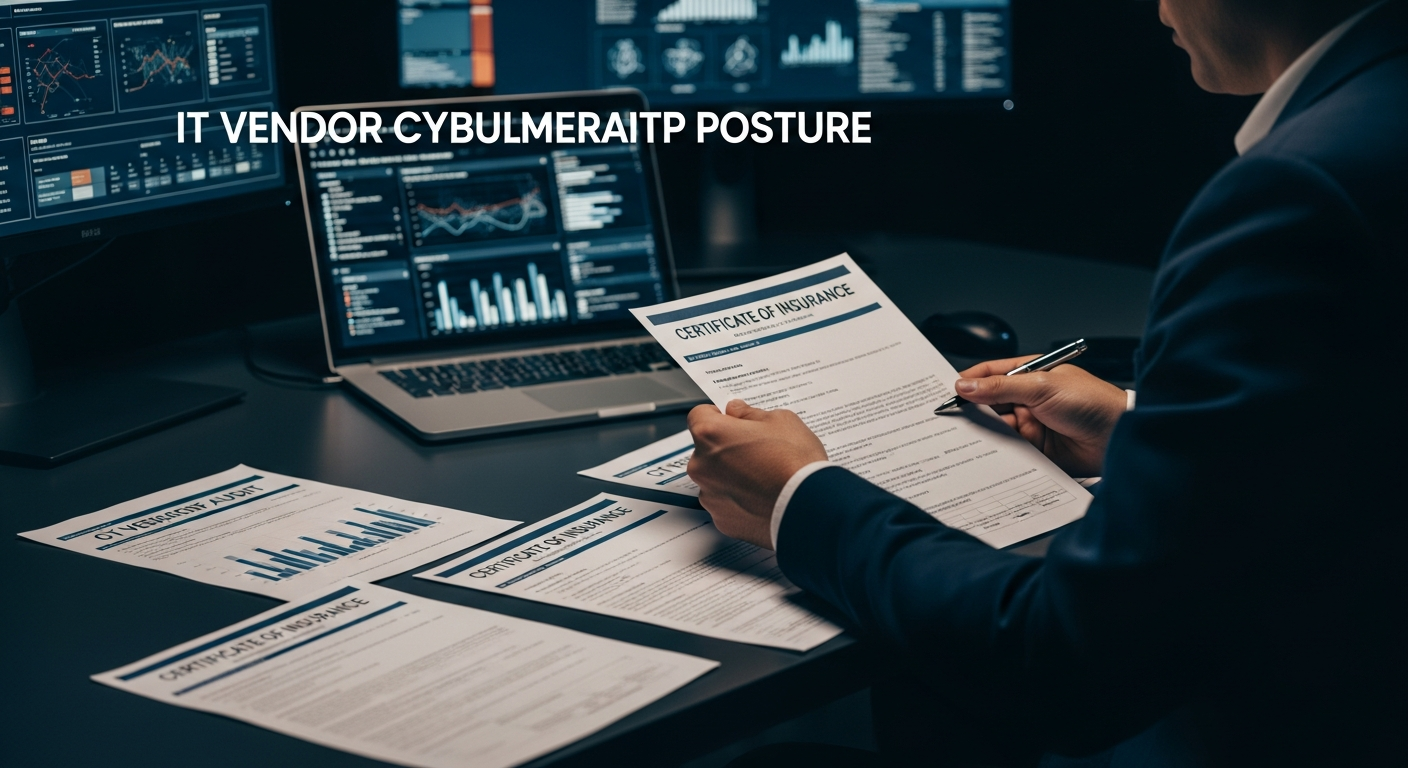
Ask for a certificate of insurance. Any legitimate business provides one without hesitation. If you get pushback, treat it as a serious red flag. The Cybersecurity and Infrastructure Security Agency (CISA) has published guidance on supply chain risk that specifically addresses the danger posed by third-party vendors with inadequate security programs. Your IT provider is, in every meaningful sense, a member of your supply chain.
2. How Is the IT Vendor Cybersecurity Posture Audited for Internal Access Controls?
Access controls determine who inside the vendor’s own organization can reach your data and systems. The question is not just whether those controls exist — it is whether anyone independent verifies them on a regular schedule. A vendor’s IT vendor cybersecurity posture is only as strong as the processes enforcing those controls day to day.
A strong answer describes a formal process: periodic access reviews, role-based permissions that limit each technician to only what they need, multi-factor authentication on all administrative accounts, and documented offboarding procedures that revoke access the moment someone leaves. An honest vendor will also describe how that process is reviewed — by an internal security lead, an external auditor, or both.
A weak answer sounds like: “We have good controls in place” or “We trust our team.” Trust is not an access control. Neither is culture. You are looking for evidence of a repeatable, documented process that does not depend on any one person’s judgment on any given day.
This matters because the most common attack vector against businesses is not a sophisticated external hack. It is a compromised credential — often belonging to someone inside a trusted vendor. The technician who had legitimate access to your environment six months ago and never had it revoked is a vulnerability. A well-run IT firm knows this and has built processes to prevent it.
3. Has the Vendor’s IT Vendor Cybersecurity Posture Ever Failed a Client?
This is the question most vendors are least prepared to answer. Many will simply say no without elaboration. That may be true — but the follow-up matters: if they have never experienced a client-impacting breach, ask them why they believe that is the case. The answer reveals how seriously they take the question.
A vendor who responds with “we’ve been lucky” is not a vendor you want holding your credentials. A vendor who walks you through the specific security architecture, monitoring practices, and audit history that make a client-impacting breach unlikely — that is a different conversation entirely.
If a vendor has experienced a breach, that is not automatically disqualifying. How they handled it, what they disclosed, what they changed, and whether clients were notified promptly and honestly matters far more than the fact that it happened. A vendor who came through an incident with a stronger program can be a more valuable partner than one who has simply never been tested.
At Xact IT, we can answer this question directly: zero client breaches across every client we have served since our founding in 2004. We do not say that to impress anyone. We say it because it is verifiable, it is rare in this industry, and it reflects the same architecture and discipline we bring to every client relationship. We earn it every year.
4. Who Controls Privileged Access Under Your IT Vendor Cybersecurity Posture?
Privileged access means administrative-level credentials — the kind that can install software, reset passwords, export data, or modify security configurations. Every IT services firm needs some level of privileged access to manage your environment. The question is: how many people have it, under what conditions, and what happens to that access when a project ends or an employee leaves?
A well-run IT firm limits privileged access to a small number of named individuals, logs every use of that access, and reviews those logs regularly. They use access management tools that require a separate authentication step even for internal technicians. They also maintain a formal inventory of every system they hold administrative credentials to — and they can show you yours.
Ask directly: “How many of your employees have administrative access to my environment, and what would happen to that access today if one of them resigned?” If the answer is vague or uncertain, that uncertainty lives inside your network right now. That is not an abstract risk. It is a concrete, present one.
For context on what a mature access management program looks like, the NIST Cybersecurity Framework provides a widely respected reference for identity management and access control. A vendor unfamiliar with this framework is probably not maintaining a mature IT vendor cybersecurity posture internally either. See our own cybersecurity services page for how we approach this for every business we manage.
5. What Third-Party Validation Supports the Vendor’s IT Vendor Cybersecurity Posture?
Any vendor can claim strong internal security. Third-party validation is what separates a claim from a fact — and it is the hardest thing to fake.
Ask whether the vendor has undergone an external audit of their IT vendor cybersecurity posture. Not a self-assessment checklist — an independent evaluation conducted by a qualified assessor. Ask what framework that audit was conducted against, who performed it, and how recently it was completed. Ask if they can share the results or a summary.
Recognized frameworks an IT services firm might be audited against include ISO 27001 controls and the CIS Critical Security Controls. What matters is that the audit was conducted by someone with genuine credentials and that the results are not sealed by default.
Xact IT holds the GTIA Cybersecurity Trustmark, audited annually since 2021 by Versprite — a CREST-accredited assessor — against CIS Critical Security Controls IG2 with supplementary ISO 27001 controls. It renews every year. We are not aware of many IT firms in our market who can say the same. We raise it not to position ourselves, but to show what third-party validation of an IT vendor cybersecurity posture actually looks like in practice. If a vendor you are evaluating has never been through anything comparable, ask them why.
Red Flags That Signal a Weak IT Vendor Cybersecurity Posture
Beyond specific answers, how a vendor responds to these questions tells you a great deal about how they will behave as a long-term partner.
- They become defensive or evasive when asked about their own security practices
- They redirect every question back to what they will do for you, rather than addressing what they do internally
- They cannot name a specific framework their security program is built around
- They are unwilling to provide a certificate of insurance or refer you to their broker
- They claim they have never had a security incident but cannot explain why — no architecture, no audit history, no program to point to
- They use “we take security seriously” as a complete answer
- Their team cannot clearly explain who holds administrative access to client environments
A vendor who gets frustrated that you are asking these questions is telling you something important. A vendor who is genuinely confident in their IT vendor cybersecurity posture welcomes the conversation. They have thought about it. They have documented it. They can walk you through it without hesitation because they built something worth walking you through.
What a Strong IT Vendor Cybersecurity Posture Looks Like
A vendor with a mature IT vendor cybersecurity posture will not wait for you to ask. They will come to early conversations ready to discuss their insurance coverage, audit history, access control architecture, and breach record. They will have a clear answer to who holds privileged access and a documented process for managing it. They will name the framework their security program is measured against and the third party who did the measuring.
Beyond documentation, the right vendor treats internal security as a core business practice — not a compliance checkbox, not a marketing claim, not something they got around to once. They audit it, renew it, and improve it on a schedule that does not depend on a client asking first.
You should also look for operational calm. Vendors who have invested seriously in their own IT vendor cybersecurity posture tend to run quieter operations. Fewer emergencies. Fewer surprises. Fewer moments where someone is scrambling to explain what went wrong. We call it selling quiet. Our managed IT services are built on the same principle we apply to our own shop: no drama, no breaches, no board-level surprises.
How to Decide Based on IT Vendor Cybersecurity Posture
After walking through these five questions with every vendor on your short list, the decision framework gets simple. You are not comparing feature lists — you are comparing how each vendor treats the question of their own accountability. That is the most predictive signal you have.
A vendor who cannot demonstrate a sound IT vendor cybersecurity posture is asking you to trust them with your business while holding themselves to a lower standard than they would apply to you. That asymmetry is not just uncomfortable — it is a liability. The IT services agreement you sign defines the relationship. Make sure you know the security posture of the company whose name is on the other side of it.
The best IT providers do not just protect client environments. They protect their own with the same discipline, the same rigor, and the same accountability they promise you. When those two things match, you have found a real partner. When they do not, you have found a vendor that is better at selling than it is at securing. In this industry, that is the distinction that matters most.
For further reading on evaluating third-party vendor risk, the full range of services we offer reflects the same standards we hold ourselves to — and that we recommend you hold every IT vendor to before you sign anything.
Frustrated With Your Current IT Provider?
If your current MSP isn’t catching the things this post describes, that’s a signal worth acting on. Book a strategy call and we’ll walk through what an honest IT partnership looks like for a business your size.