
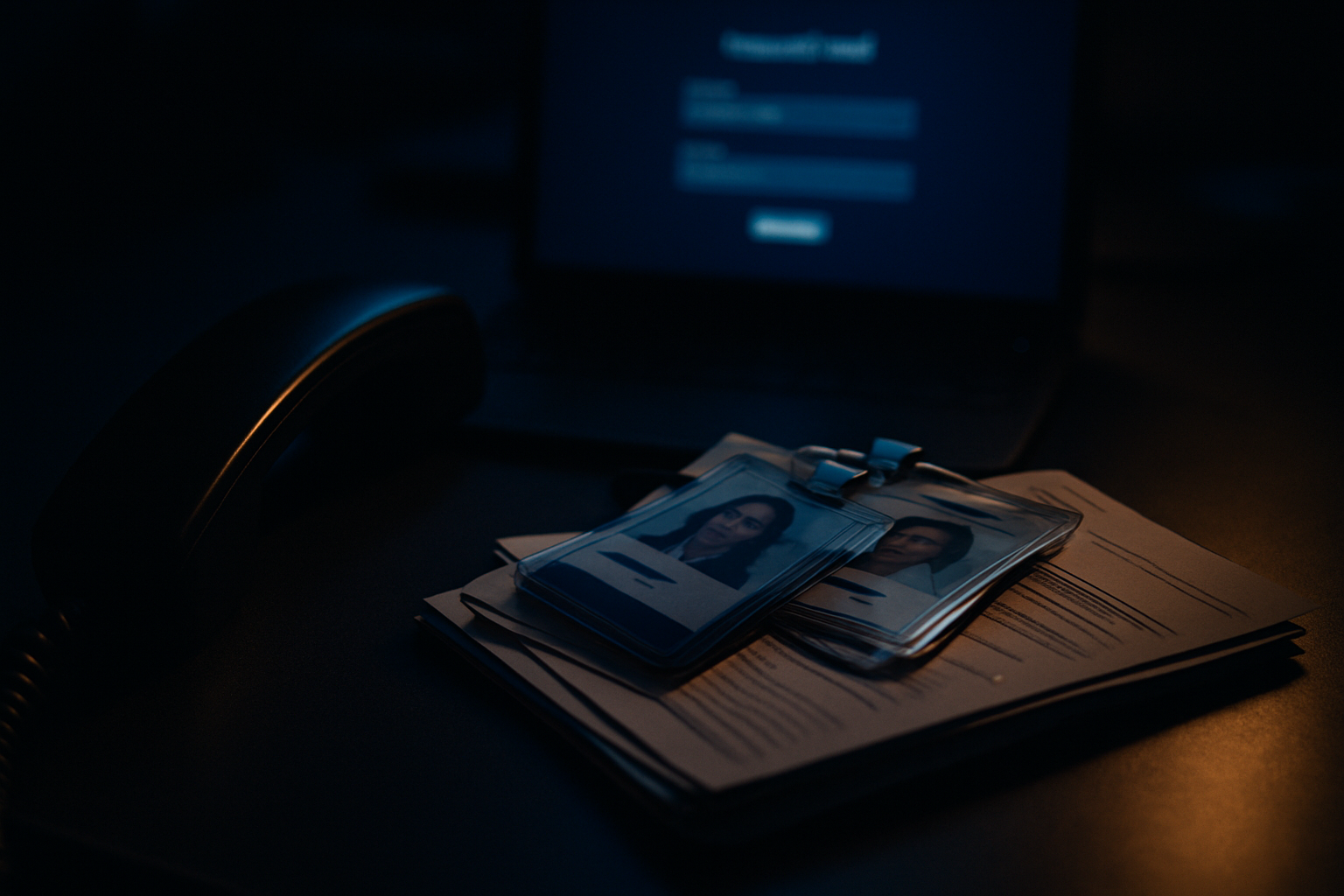
Social engineering attacks on IT helpdesks are no longer a footnote in threat intelligence reports. In 2025, a well-documented wave of impersonation campaigns has hit small and mid-sized businesses specifically because their IT support workflows are predictable, lightly guarded, and almost never treated as a security boundary. If your company has a process for resetting passwords or granting emergency access, that process is now a known attack vector – and threat actors are actively mapping it.
- What Happened: The 2025 Helpdesk Impersonation Wave
- Why Helpdesks Are the Target
- Why Small Businesses Face Higher Exposure Than They Realize
- What Attackers Know About Your Support Workflow That You Might Not
- What a Well-Run IT Environment Has in Place
- The Hard Questions to Ask Right Now
- The Takeaway for Business Owners
What Happened: The 2025 Helpdesk Impersonation Wave
Throughout 2025, security researchers and government agencies have tracked a sharp increase in social engineering attacks on IT helpdesks – threat actors calling or messaging IT support teams while posing as legitimate employees. The script rarely varies: an urgent situation, a locked account, a time-sensitive deadline, and a request to reset credentials or grant access immediately.
The Cybersecurity and Infrastructure Security Agency (CISA) has flagged social engineering via phone and messaging channels as one of the most consistently effective initial-access techniques in active use. The reason is straightforward: it bypasses technical controls entirely by targeting the human on the other end of the ticket.
These are not random phishing emails. They are scripted, researched, and timed. Attackers mine LinkedIn, public company directories, and previously breached data to learn employee names, their managers, and in some cases the name of the IT support vendor. They call sounding credible because they have done their homework.
Why Helpdesks Are the Target of Social Engineering Attacks
The helpdesk exists to solve problems quickly. Speed and helpfulness are how support teams are measured. That cultural imperative – fix the problem, help the user, do it fast – is exactly what attackers exploit.
A support technician who takes a call from someone who knows the employee’s name, department, and manager has very little built-in friction standing between them and a password reset. If there is no formal identity verification protocol, the technician is making a judgment call under time pressure. Attackers are counting on that.
Here is the direct version: the helpdesk is not just a support function. It is an access control boundary. Every password reset, every account unlock, every permission change that flows through it is a potential entry point. When that boundary has no documented verification process, it is not a boundary at all – it is an open door with a friendly face in front of it.
Why Small Businesses Face Higher Exposure Than They Realize
Large enterprises have identity governance teams and formal change management processes that create natural friction. Small businesses typically do not. A 30-person company in South Jersey is more likely to handle IT support through informal channels – a text to the IT contact, a quick call, an email marked urgent. Informality feels efficient. It is also the exact environment where helpdesk impersonation attacks thrive.
A few structural reasons why the exposure runs higher for smaller organizations:
- Support interactions happen across inconsistent channels – phone, email, Slack, text – making it harder to enforce any single verification standard.
- Staff turnover means technicians may not personally recognize every voice or face, especially in remote and hybrid environments.
- When IT is outsourced, there is a trust handoff: the business trusts the IT firm, and the IT firm trusts the caller – with no formal verification protocol between them.
- There is rarely a documented procedure for what a technician should do when something feels off about a request.
None of these are failures of intelligence or effort. They are natural consequences of how small businesses operate. But in 2025, operating without a formal identity verification process is a documented risk – not just a loose end.
What Attackers Know About Your Support Workflow That You Might Not
This is the part that lands hardest with business owners: attackers often have a more detailed picture of your IT support process than you do.
Before a targeted helpdesk call, a prepared attacker may already know:
- The name of your IT support company and how to reach their helpdesk line.
- The names and titles of several employees, sourced from LinkedIn or a prior data breach.
- Which software platforms your company uses, often inferred from job postings or public profiles.
- Roughly what language your helpdesk uses in confirmation emails – sometimes pulled from a prior breach at a company using the same vendor.
Armed with that information, an impersonation call takes minutes to script and seconds to execute. The technician on the other end has no idea they are talking to someone who spent two hours preparing for that conversation.
This is not a hypothetical. The 2023 MGM Resorts breach – widely covered and publicly documented – began with a ten-minute phone call to an IT helpdesk. The attacker found an employee on LinkedIn, called the support line, and used publicly available information to pass verbal identity verification. The resulting breach cost the company an estimated $100 million. MGM is not a small business, but the technique scales perfectly to any organization with a helpdesk and no formal caller verification protocol.
What a Well-Run IT Environment Has in Place to Defend Against Social Engineering Attacks on IT Helpdesks
A well-run IT environment treats the support process as part of the security architecture – not a separate operational function. That means specific things are true before a ticket is ever opened.
First, identity verification for sensitive requests is formalized and non-negotiable. A caller claiming to be an employee does not get a password reset because they know their own name and manager. There is a documented secondary verification step that cannot be socially engineered in real time – typically something out-of-band, like a push notification to a pre-registered device or a callback to a number on file, not the number the caller provides.
Second, certain categories of requests require escalation regardless of urgency. “I need this right now” is not a reason to skip verification. A well-designed support process builds in the right friction at the right moments – not to slow down legitimate users, but to make impersonation expensive enough that attackers move on.
Third, technicians are trained specifically on social engineering attacks on IT helpdesks, not just phishing emails. Most security awareness training focuses on email. Phone-based and chat-based impersonation requires separate attention because the psychological dynamics are different. A live caller creates urgency and social pressure in ways a phishing email cannot replicate.
Fourth, every sensitive action is logged and attributable. If a password reset happens at 11:47 PM on a Thursday, someone should be able to trace exactly who approved it, through what channel, and what verification was completed. If that log does not exist, an attack may not surface until long after the damage is done.
According to the NIST Cybersecurity Framework, identity verification and access management controls – including those governing human-layer support interactions – are foundational elements of a mature security posture. Organizations of all sizes are expected to document and enforce these controls, not treat them as aspirational.
At Xact IT, this architecture is part of how we design managed environments from the ground up. Our cybersecurity practice is built on the principle that access controls are only as strong as the processes that govern them. The technical layer and the human layer have to be designed together – not bolted on separately and hoped to work in sync. You can also see how we structure these protections across our managed IT services.
The Hard Questions to Ask Right Now
You do not need to be technical to ask these questions. You just need to be willing to hear an honest answer.
- What happens when someone calls your helpdesk claiming to be one of our employees and asks for a password reset? Walk me through the exact steps.
- Is that process written down, or does it depend on the technician’s judgment in the moment?
- What would stop an attacker who knew the employee’s name and manager’s name from getting that reset?
- Are sensitive actions like account unlocks and permission changes logged? How long are those logs retained?
- Has your team received specific training on phone-based and chat-based impersonation – not just email phishing?
If the answers are vague, incomplete, or met with defensiveness, that is information. A well-run IT environment answers every one of those questions precisely and without hesitation. The inability to do so is not necessarily a sign of a bad team – it may mean the process has never been formally reviewed. But “we have never thought about it that way” is not a safe position in 2025.
The Takeaway for Business Owners
The 2025 helpdesk impersonation campaigns are not a new category of attack. Social engineering has been a documented threat for decades. What has changed is the scale, the depth of research attackers conduct beforehand, and the degree to which small and mid-sized businesses are now explicitly in scope. Attackers have learned that large enterprises have hardened their technical perimeters, so they are targeting the human layer at organizations that have not yet formalized it.
Your IT support process was designed to help your team. That is exactly why social engineering attacks on IT helpdesks are now so prevalent – and why your support workflow is a target. The companies that get through the next several years without a breach are the ones that treat their support workflows with the same discipline they bring to their firewalls and endpoint protection. The human layer is not separate from your security posture. It is part of it – and in many cases, it is the weakest part.
We have maintained a zero client breach record across every organization we have served since 2004. That is not luck. It is the result of treating access control as a complete system – from the technical stack all the way through to how a technician answers the phone. If you are ready to close that gap, explore our full range of IT and security services – or Book a Free Cybersecurity Strategy Call and we will show you exactly where your support process stands.
Want a Walkthrough of Your Own Setup?
Twenty minutes on the phone with our team gets you specific recommendations you can use immediately — whether you hire us or not. No pitch, no pressure, just an honest read on where your business stands.