
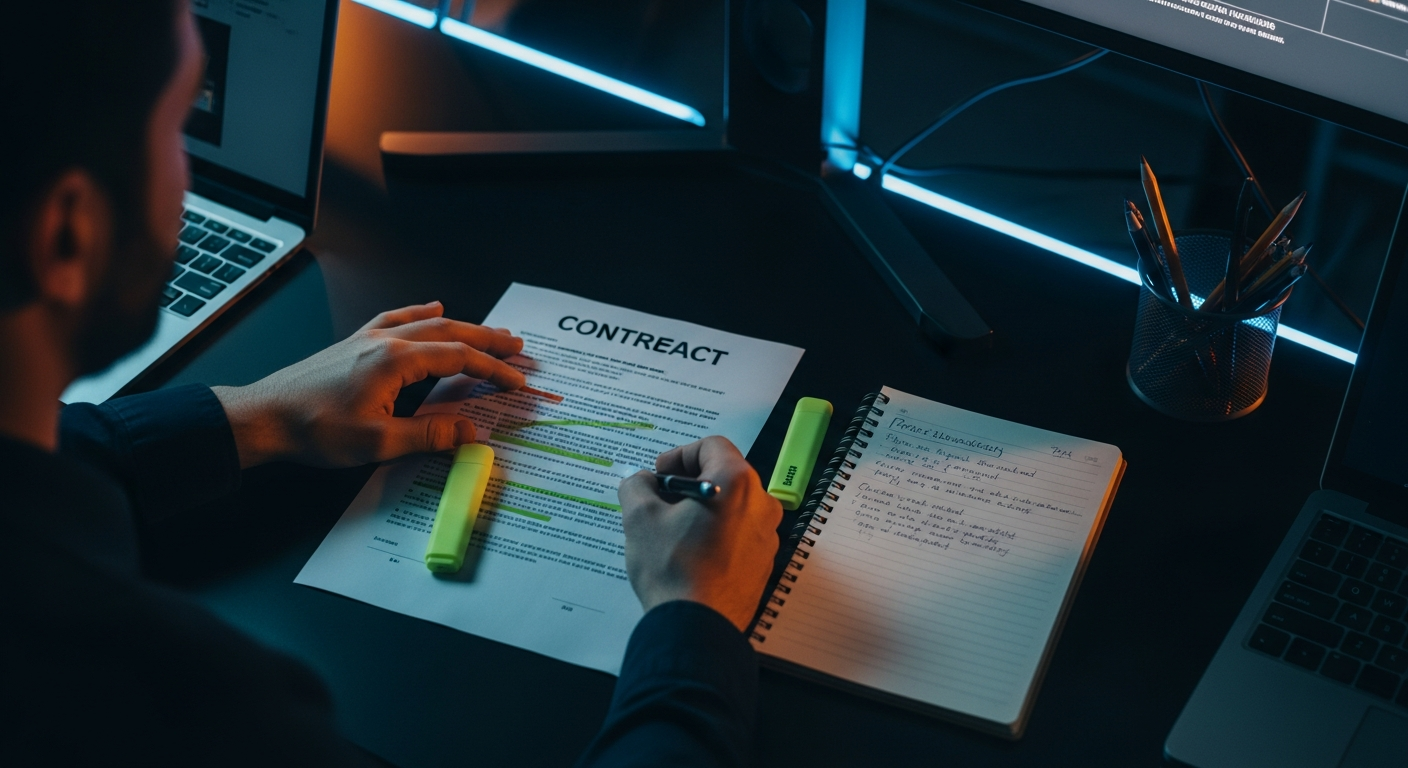
Most small business owners hand a vendor contract to their attorney without reading it first. That is an expensive habit. A structured AI contract review takes twenty minutes and gets you to that attorney conversation already knowing what to ask – which clauses are one-sided, what is missing, and where the real exposure sits. This post gives you the exact workflow and prompts to make that happen.
- Why AI Should Be Your First Pass, Not Counsel
- What Non-Standard Language Actually Looks Like
- The Practical Workflow: Step by Step
- Specific Prompts That Surface Real Risk
- What AI Will Miss (And Why That Still Leaves You Ahead)
- Building This Into Your Business
- The Bigger Picture: AI as a Business Operating Layer
Why AI Contract Review Should Be Your First Pass, Not Counsel
Business attorney time runs $300 to $600 per hour depending on your market. That is a fair rate for legal judgment. It is a poor rate for document scanning. A significant portion of a standard contract review – flagging whether an indemnification clause is mutual or one-sided, spotting a liability cap set at zero, catching a termination clause that locks you in for 90 days while the vendor can exit in 15 – is pattern recognition in text, not legal reasoning.
AI is well-suited to pattern recognition in text. Large language models like GPT-4 and Claude have been trained on substantial volumes of legal documents, contract templates, and case commentary. They will not give you legal advice. They will flag the same structural problems your attorney would flag – before you pay for the first hour.
The practical result: you arrive at that attorney conversation with a marked-up document, a short list of specific concerns, and pointed questions. Your attorney spends thirty minutes on substance instead of ninety on scanning. You spend less, move faster, and understand the contract better yourself.
What Non-Standard Language Actually Looks Like

Before you build a workflow, you need to know the four categories of contract language that cause the most downstream damage to small businesses. These are exactly the patterns an AI first pass is built to surface.
One-Sided Liability Caps
Most vendor contracts cap how much either party can owe the other if something goes wrong. A balanced contract caps liability at total fees paid over the prior twelve months. A one-sided version caps the vendor’s liability at one month of fees – or at zero for certain categories of loss – while leaving your exposure unlimited. AI identifies these mismatches quickly because the structure gives it away: the cap language for one party simply does not mirror the other’s.
Missing or Asymmetric Indemnification
Indemnification clauses determine who pays if a third party sues over something that happened under this contract. A vendor whose software gets breached and exposes your customer data may try to shift that liability entirely to you if the indemnification language was drafted in their favor. The absence of mutual indemnification – or the presence of broad carve-outs that exempt the vendor from most real-world scenarios – is a red flag an AI pass will catch as either a missing element or an unusual clause structure.
Termination Asymmetry
Termination clauses are where small businesses get hurt most often in practice. You signed a two-year agreement requiring 90 days written notice. The vendor can exit with 15 days notice for convenience. You are locked in. They are not. AI catches this because it can compare the termination rights spelled out for each party within the same clause and flag the structural imbalance in plain language.
Auto-Renewal and Price Escalation Language
Many vendor contracts bury automatic renewal provisions in the same clause that lets the vendor adjust pricing at renewal without your consent. Missing the renewal window by a single day can lock you into another year at a higher rate. AI will surface these clauses when prompted correctly because the pattern – auto-renewal paired with unilateral price change authority – is a recognizable structure.
The Practical Workflow: Step by Step
Here is the process used internally at Xact IT when reviewing a vendor agreement before it reaches legal counsel. Adapt it for any contract type.
Step 1: Convert the contract to clean text. Most contracts arrive as PDFs. Use Adobe Acrobat, Smallpdf, or the built-in PDF-to-text feature in your AI tool to extract the text. Review the output before proceeding – tables and columns sometimes scramble on extraction.
Step 2: Open your AI tool of choice. GPT-4 (via ChatGPT) and Claude (via Anthropic) are both capable here. Claude handles longer documents more reliably at this writing due to its larger context window – relevant for contracts over 20 pages.
Step 3: Paste the contract text and run your first-pass prompts. The prompts in the next section are designed to run sequentially, not as one large query. Separate prompts return cleaner, more actionable output.
Step 4: Build a flag log. As the AI returns findings, copy each flagged item into a simple document with the clause reference (section number and a short quote), what the AI flagged, and a column for your attorney to respond. This becomes the working document for your legal review call.
Step 5: Brief your attorney. Send the flag log before the call. An attorney who walks in with twelve specific questions to answer will move faster – and cost less – than one reading a 40-page agreement cold.
Specific Prompts That Surface Real Risk in AI Contract Review
Paste these directly into your AI tool after loading the contract text. They are intentionally specific. Vague prompts return vague output.
Liability Cap Prompt
“Review the liability sections of this contract. For each party, identify: (1) the maximum amount that party can owe the other under the liability cap, (2) any categories of loss excluded from the cap entirely, and (3) whether the caps are structured symmetrically between both parties. Flag any clause where one party’s exposure is materially greater than the other’s.”
Indemnification Audit Prompt
“Identify all indemnification provisions in this contract. For each one, state: (1) who is indemnifying whom, (2) what events or scenarios trigger the obligation, (3) whether the obligation is mutual or one-directional, and (4) whether there are carve-outs or exceptions that significantly limit the indemnitor’s obligation. Flag any scenario where one party bears substantially more indemnification risk.”
Termination Rights Prompt
“List all termination rights in this contract, organized by which party holds each right. For each right, identify: (1) whether it is termination for cause, for convenience, or both, (2) the required notice period, (3) any financial penalties or obligations that survive termination, and (4) whether the same rights are available to both parties. Flag any asymmetry where one party has more or faster exit options than the other.”
Auto-Renewal and Price Change Prompt
“Find any provisions related to contract renewal, automatic renewal, or price changes. For each: (1) identify the renewal term and how it is triggered, (2) note the deadline by which either party must provide notice to avoid automatic renewal, (3) identify whether either party has the right to change pricing at or after renewal without the other party’s written consent. Flag any clause where automatic renewal and unilateral price adjustment appear together.”
Missing Protections Prompt
“Based on this contract type and the obligations described, identify any of the following that appear to be absent or unusually weak: mutual indemnification, data breach notification obligations, limitation of consequential damages, dispute resolution process, governing law clause, and intellectual property ownership for any work product created under this agreement. For each missing item, note its absence and explain briefly why it is typically included in this type of contract.”
Running all five prompts on a single contract takes 20 to 30 minutes. The output gives you a structured flag log that most business attorneys will tell you is more useful than a blank contract handed to them cold.
What AI Will Miss (And Why That Still Leaves You Ahead)
AI contract review is not a substitute for a lawyer. Knowing what the first pass does not catch is as important as knowing what it does.
- AI will not know the negotiating history behind a specific clause – only your attorney will know that this vendor always accepts mutual indemnification when pushed.
- AI cannot assess enforceability under your state’s specific case law – a clause that looks non-standard may be routinely enforced in New Jersey and routinely voided in California.
- AI will not catch ambiguity the way a litigator will – a clause can be grammatically clear and still be legally ambiguous when applied to a real dispute.
- AI sees only the document in front of it – not what was represented verbally or in prior email threads.
- AI does not make the judgment call about what is worth negotiating. Not every one-sided clause is worth the deal friction to push back on.
None of that makes the AI first pass less valuable. It means the AI pass makes your attorney’s judgment faster, cheaper, and better-informed. You are not skipping legal review. You are making it more efficient.
The National Institute of Standards and Technology’s AI Risk Management Framework is worth reading if you want a structured way to think about where AI assistance is appropriate versus where human judgment must lead. Written for enterprises, but the underlying logic on human oversight applies directly to AI-assisted legal triage at any company size.
Building This Into Your Business
The workflow above works as a one-off, but the real value comes from making it standard practice. Here is what that looks like.
- Save your five prompts in a shared document – a Google Doc, Notion page, or a secure internal wiki – so anyone can run the process without starting from scratch.
- Set a policy: no vendor agreement over a defined dollar threshold (say, $5,000 annual value) goes to legal without an AI flag log attached.
- Assign the first-pass task to whoever handles vendor relationships. It requires no technical skill – only the ability to follow a prompt sequence and document the output.
- Keep a running log of flagged clauses by vendor category. Over time you will build institutional knowledge about which vendor types consistently use which problematic structures.
This is what practical AI adoption looks like for a 20 to 200 person company – not a platform purchase or a change management project, but a specific workflow where AI handles the first pass on a repeatable task and a human handles the judgment work. That is the pattern that sticks.
If you want to understand how AI workflow integration fits alongside your broader IT and security posture, our managed IT services practice is built around exactly that kind of operational integration – AI as a working layer of how your business runs, not a standalone experiment. You can also explore how we approach technology services for small businesses across the full range of operational needs.
The Bigger Picture: AI as a Business Operating Layer
AI contract review is one workflow. But it illustrates where AI is actually useful for small businesses right now. The value is not in general AI assistants or chatbots. It is in specific, repeatable tasks where the cost of human-only execution is high, the pattern recognition required is well-defined, and the output is high-stakes enough to warrant care but auditable enough that a human can verify the result.
Contract triage fits all three criteria. So does vendor due diligence research, board meeting preparation, and policy document drafting. The companies moving ahead right now are not the ones experimenting with every new AI tool. They are the ones who identified three to five specific workflows, built a repeatable process around AI assistance for each, and held the line on human review for the judgment calls that matter.
AI contract review is a good first workflow to nail because the return is immediate and measurable: attorney hours saved, money not spent, and faster decisions on whether to sign, push back, or walk away. Build this one first, run it for ninety days, and the right next workflow will make itself obvious.
Want to talk through where AI can remove the most friction in your business operations? Book a Free AI Strategy Call – a 20-minute conversation with our team, no obligation.
Want a Walkthrough of Your Own Setup?
Twenty minutes on the phone with our team gets you specific recommendations you can use immediately — whether you hire us or not. No pitch, no pressure, just an honest read on where your business stands.